
Picture this: it’s a random Tuesday in November, your team is playing on a court that looks nothing like their usual home floor, and the broadcast keeps flashing a “Group Standings” graphic you’ve never seen before. Nobody paused to explain any of it. That’s the Emirates NBA Cup in a nutshell — a full tournament quietly running inside the regular season, with its own groups, its own tiebreakers, and its own path to a trophy, and almost no one tells you the rules until you’re already three questions deep. Here’s the version that actually walks you through it: who plays whom, which games are real and which one isn’t, how a tie gets settled, and what it takes for a team to go from a Tuesday night group game to hoisting the Cup.
The Emirates NBA Cup is a mini-tournament played inside the NBA regular season. All 30 teams are split into six groups of five and play four “Group Play” games each. The best team from every group, plus one wild card per conference, advance to single-elimination Quarterfinals, Semifinals, and a Championship. Every game counts as a real regular-season game except the final, and players on the winning team split a seven-figure prize pool.
What Is the Emirates NBA Cup?
The Emirates NBA Cup is the NBA’s in-season tournament, first launched under the name “In-Season Tournament” and later rebranded after a sponsorship deal with the Dubai-based airline. Unlike the playoffs, it happens in the middle of the regular season — mostly across October and November — and gives every team a shot at a separate trophy, extra prize money, and a spot on a neutral-site stage, all before the calendar even hits December.
The idea behind it is simple: the NBA wanted meaningful, competitive games earlier in the season, when fan attention often drifts toward football. Turning a stretch of regular-season games into a standalone knockout tournament gave those games real stakes.
How the Tournament Format Works
The Emirates NBA Cup runs in two distinct stages. Understanding the difference between them is the key to understanding the whole tournament.
The Four-Game Group Stage
All 30 teams are divided into six groups of five — three groups in each conference. Every team plays one game against each of the other four teams in its group, for four total “Group Play” games. Two of those games are at home and two are on the road, following a set pattern explained below. These games are scheduled on specific nights, often called “Cup Nights,” and every game played on those nights is a Group Play game — there are no other NBA games happening at the same time.
The Single-Elimination Bracket
Once Group Play wraps up, eight teams move on: the top team from each of the six groups, plus one “wild card” from each conference — the second-place team with the best Group Play record in that conference. From there, it’s win-or-go-home: Quarterfinals, then Semifinals, then the Championship game. Lose once in this stage, and the tournament is over for your team; win, and you move one step closer to the trophy.
How the Groups Are Decided: The Pot System
Groups aren’t chosen randomly from scratch — they’re built using a seeded draw. Every team is ranked by its record from the prior season and split into five tiers, or “pots,” per conference, best records in Pot 1 down to the weakest in Pot 5. One team from each pot is then randomly drawn into each of the three groups per conference, so every group ends up with exactly one team from each tier instead of accidentally stacking all the strong (or weak) teams together. For the full team-by-pot breakdown and this year’s actual groups, see our Emirates NBA Cup 2026 groups page — what matters for understanding the format is what that pot placement locks in for each team’s schedule, covered next.
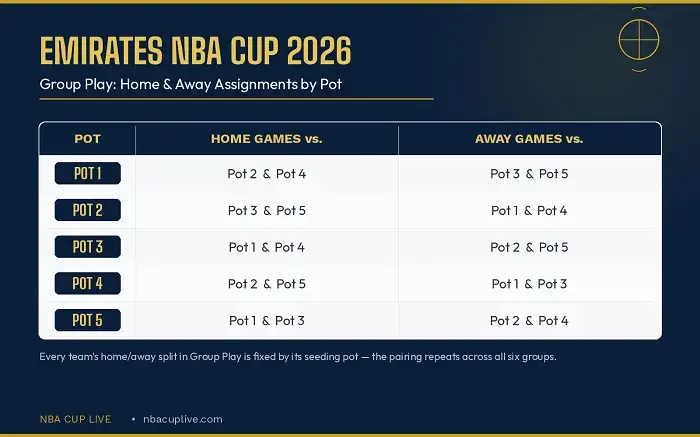
Home and Away Games: How the Schedule Splits
Here’s a detail almost nobody explains clearly: which of your team’s four Group Play games are at home isn’t random — it’s fixed by which pot your team is in. The league pairs pots together in a set home/away pattern that repeats across every group, in every conference:
| Your Pot | Home Games Against | Away Games Against |
|---|---|---|
| Pot 1 | Pot 2, Pot 4 | Pot 3, Pot 5 |
| Pot 2 | Pot 3, Pot 5 | Pot 1, Pot 4 |
| Pot 3 | Pot 1, Pot 4 | Pot 2, Pot 5 |
| Pot 4 | Pot 2, Pot 5 | Pot 1, Pot 3 |
| Pot 5 | Pot 1, Pot 3 | Pot 2, Pot 4 |
In practice, this means a Pot 1 team (one of the conference’s strongest teams from last season) always hosts its games against Pot 2 and Pot 4, while traveling to face Pot 3 and Pot 5. Every team in the league follows this same home/away logic based purely on its pot — it’s one of the more predictable parts of an otherwise randomized draw.
What Happens When Teams Tie
Because each team only plays four Group Play games, ties at the top of a group are common. When that happens, the NBA works through a fixed tiebreaker sequence — head-to-head record first, then Group Play scoring margins (overtime points don’t count toward these), then prior-season record, with a random drawing as the final fallback. The same sequence, minus the head-to-head step, decides which second-place team in each conference claims the wild card. The short version: a single lopsided win in November can end up deciding who gets a home Quarterfinal in December.
How Knockout Round Seeding Works
Seeding for the Quarterfinals isn’t a blind draw either. In each conference, the two teams with the best Group Play records host Quarterfinal games, and the top overall team hosts the wild card. From the Quarterfinals onward, every round is played at the home arena of whichever team had the better Group Play record — and that now holds true through the Semifinals as well. Only the Championship moves to a neutral site.
The One Game That Doesn’t Count
Every game up through the Semifinals counts fully toward a team’s regular-season record and stats — only the Championship sits outside the standings entirely. The part that trips people up: since the Cup doesn’t add extra games for everyone equally, teams eliminated before the final rounds get their missing regular-season games scheduled separately on the tournament’s off-nights, which is why some team schedules show “TBD” slots for weeks at a time.
Prize Money and Awards
Beyond the trophy, players on the teams that reach the Knockout Rounds split a real cash prize pool, with bigger payouts the further a team advances. The exact amount increases slightly every season under a formula built into the NBA’s labor agreement. For the full current breakdown by round, how two-way players and coaches get paid, and why the numbers keep rising, see the Emirates NBA Cup prize money breakdown.
On top of the money, a media panel votes on a tournament Most Valuable Player and an All-Tournament Team at the end of the competition, based on performance across both Group Play and the Knockout Rounds.
Emirates NBA Cup Glossary for Beginners
- Cup Night
- A night on the schedule reserved exclusively for Group Play games — no other NBA games are played at the same time.
- Group Play
- The first stage of the tournament, where each team plays four games against the other teams in its group.
- Wild Card
- The second-place team in its group, from each conference, with the best overall Group Play record — it earns an extra spot in the Knockout Rounds.
- Knockout Rounds
- The single-elimination stage of the tournament: Quarterfinals, Semifinals, and the Championship.
- Pot
- A seeding tier used to build balanced groups, based on each team’s record from the prior season.
Frequently Asked Questions
Do Emirates NBA Cup games count as regular-season games?
Yes, all of them do except the Championship game, which is played outside the regular-season record entirely.
How many teams make the Knockout Rounds?
Eight teams: the winner of each of the six groups, plus one wild card team from each conference.
How are Emirates NBA Cup groups decided?
Teams are sorted into five pots per conference based on the prior season’s record, then one team from each pot is randomly drawn into each group, keeping every group balanced.
What happens if teams finish Group Play tied?
The NBA works through a fixed sequence starting with head-to-head record, moving through Group Play scoring margins, then prior-season record, with a random draw as the last resort.
Where is the Emirates NBA Cup Championship played?
The Championship is played at a single neutral-site arena chosen by the league — Hinkle Fieldhouse in Indianapolis for 2026. The Semifinals, unlike in past years, are now played at the home arena of the higher-seeded team rather than at a neutral site.
For live updates, scores, and this season’s full tournament coverage, visit NBA Cup Live.