Most confusion about the Emirates NBA Cup isn’t about the rules. It’s about the thing itself. Why does a basketball league have a “cup”? Why is an airline’s name in front of it? Why is the floor suddenly painted like a screensaver? And is any of it real, or is it a November marketing exercise dressed up as a competition?
Those questions rarely get answered, because most coverage jumps straight to brackets and tiebreakers. What follows is the other half — the background, the naming, the design decisions, and the odd side effects that come from bolting a knockout tournament onto a regular season.
Short version
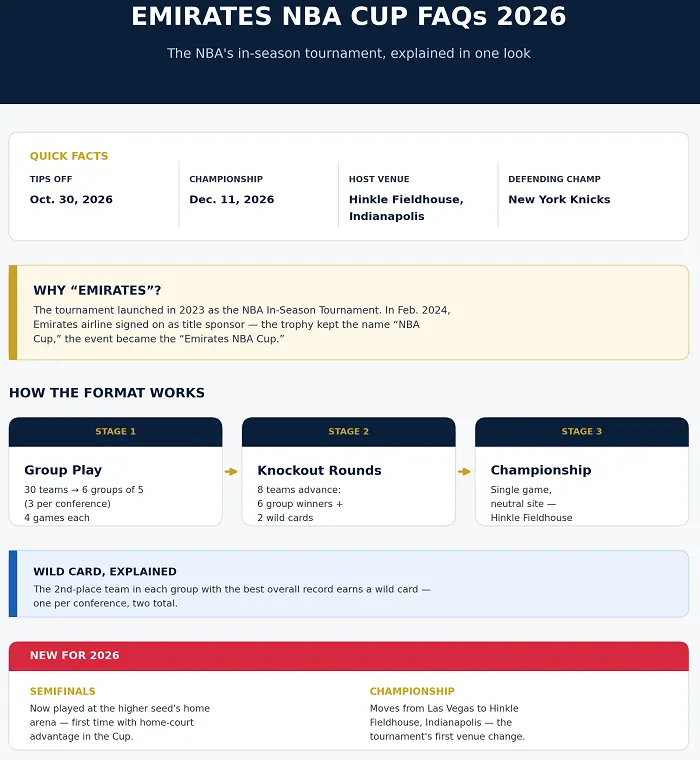
The Emirates NBA Cup is a real trophy competition the NBA borrowed from European soccer, launched in 2023 as the “NBA In-Season Tournament” and renamed after Emirates airline bought the naming rights in February 2024. The trophy was always called the NBA Cup; only the event picked up a sponsor’s name. It’s genuine — real prize money, a real MVP award, and games that count in the standings.
Why Is It Called the Emirates NBA Cup?
Because an airline paid for the name. That’s the whole answer, but the details clear up a lot of secondary confusion.
When the tournament launched in 2023, the NBA gave it a plain functional title: the NBA In-Season Tournament. The trophy the Lakers lifted that December already had its own name — the NBA Cup — but the competition around it didn’t.
On February 8, 2024, the NBA announced a multiyear global marketing partnership with Emirates, the Dubai-based airline. Emirates became the league’s official global airline partner and, as part of the deal, the first title sponsor of the tournament. The event was rebranded the Emirates NBA Cup. The trophy kept its original name.
The same agreement produced something fans notice without always connecting it: the Emirates logo patch on referee jerseys. Officials in the NBA debuted it at the 2024 All-Star Game, G League referees added it for 2024-25, and WNBA referees from the 2025 season. It was the first referee jersey patch partnership in NBA history.
Why would an airline sponsor a basketball tournament?
Emirates has spent decades buying naming rights across global sport — it sponsors the Emirates FA Cup in England, and has long-running partnerships with Real Madrid, Arsenal and AC Milan, plus a presence at the US Open in tennis. A US-facing basketball property fit an existing playbook: reach an American audience the airline wasn’t otherwise touching, using a competition format that already resembles the European cups it sponsors elsewhere.
What Was It Called Before? A Naming Cheat Sheet
Four terms get used interchangeably in broadcasts and headlines, and only two of them mean the same thing. Here’s what each actually refers to.
| Term | What it means | Still in use? |
|---|---|---|
| NBA In-Season Tournament | The original name of the competition, used only for the 2023 edition | Retired — you’ll still see it in older articles |
| NBA Cup | The name of the physical trophy, from day one | Yes — and now used casually for the event too |
| Emirates NBA Cup | The sponsored name of the competition since 2024 | Yes — the official name |
| Larry O’Brien Trophy | Unrelated. This is the NBA Finals championship trophy | Yes — different competition entirely |
So “NBA Cup” and “Emirates NBA Cup” now point at the same thing in everyday use, even though one started as a trophy name and the other is a sponsorship title.
Why Did the NBA Invent This in the First Place?
The idea came from soccer, and specifically from Commissioner Adam Silver’s interest in how European leagues structure their calendars.
In most of Europe, a club’s season runs on two parallel tracks. There’s the league — a long table decided over months — and there are separate cup competitions with their own brackets and their own trophies, played in gaps throughout the same season. A team can have a disappointing league campaign and still end the year with silverware.
The NBA had no equivalent. November games mattered exactly as much as any of the other 82, which is to say: not very much individually, at a point in the calendar when American sports attention is pointed squarely at football. A tournament with a trophy at the end gave those weeks something to play for.
The NBA’s version differs from the soccer model in one important way. European cups are usually separate fixtures added to the calendar. The NBA folded its cup into the existing schedule instead, so almost every Cup game is also a regular-season game. That single design decision is what stops teams from resting starters and treating it as an exhibition — and it’s also the source of most of the quirks below. The mechanics of how that works are laid out in the rules and format breakdown.
Why Do the Courts Look Like That?
Most-asked visual questionTurning on a Cup game and finding an unfamiliar, fully painted floor is a common first encounter with the tournament. It’s deliberate.
For Cup games, all 30 teams play on custom alternate courts — painted edge to edge with no visible woodgrain, which had never been done in the NBA before 2023. The stated goal was simple: make it instantly obvious, to anyone flipping channels, that this game isn’t ordinary. The NBA Cup trophy is rendered at center court, with trophy silhouettes in the free-throw lanes.
The designs have evolved noticeably across three editions:
- 2023 — bright, loud color schemes with a wide “runway” stripe running lane to lane. Widely mocked online. Some players complained the surfaces were slippery, and one team’s court wasn’t ready in time due to manufacturing problems.
- 2024 — a rethink by artist Victor Solomon, who also designed the trophy. The runway was dropped for three concentric circles radiating from center court in tonal shades of a team color, with a faint team graphic layered underneath at low opacity.
- 2025 — angled gradients based on each team’s core color, with the gradient direction tied to conference, plus hidden nods to previous champions worked into the design.
There’s a practical upside for fans: the court is the fastest way to tell whether a given game counts toward the Cup. If the floor is painted, it’s a Cup game. If it’s normal hardwood, it isn’t. That’s often quicker than checking a schedule, though the full Group Play schedule with broadcast details is the reliable version.
Do the uniforms change too?
Yes. Home teams wear a designated alternate uniform for Cup games, which is why a team can look unfamiliar on both the floor and the jersey on the same night.
How Is This Different From the Playoffs, the Play-In, and All-Star?
The NBA now runs four events outside the ordinary flow of the season, and they get mixed up constantly. The differences come down to timing, stakes, and whether the games count.
| Event | When | Who’s involved | Do the games count? |
|---|---|---|---|
| Emirates NBA Cup | Late Oct – mid Dec | All 30 teams, narrowing to 8 | Yes, except the final |
| All-Star Weekend | February | Selected individual players | No — exhibition |
| Play-In Tournament | April | Teams seeded 7–10 per conference | No — decides playoff seeds |
| NBA Playoffs | April – June | 16 qualifying teams | No — separate postseason |
The cleanest distinction: All-Star is an exhibition with no stakes, the Play-In and playoffs decide the league championship, and the Cup is the only one of the four that is simultaneously a real tournament and a chunk of the regular season.
The 83-Game Quirk Almost Nobody Mentions
Every NBA team plays an 82-game regular season. Except the two teams that reach the Cup final actually play 83 games.
The explanation sits in that one exception to the counting rule. The Championship game doesn’t count toward the standings or toward anyone’s regular-season statistics. So the two finalists finish their 82 scheduled games and then play one extra, entirely uncounted game on top of them.
Practical consequences that follow from this:
- A player’s scoring average won’t move based on the final, however many points they put up in it.
- Minutes played in the final don’t count toward the games-played threshold used for major individual award eligibility.
- Fantasy leagues generally don’t score the Championship, since the underlying stats aren’t recorded as regular season.
- Every other Cup game — group stage and the earlier knockout rounds — counts normally for all of these.
For anyone tracking how results ripple into the standings as they happen, the group standings and wild card race update through the tournament.
Is the Emirates NBA Cup Actually Taken Seriously?
Fair question, and the honest answer is that it has become more credible with each edition rather than arriving fully accepted.
The strongest evidence sits in the results. In three editions, three different franchises have won it — and the 2025 winner went on to win the NBA Finals that same season, against the same opponent they’d beaten for the Cup. That combination is hard to square with the idea of a throwaway event. The complete year-by-year record lives in the Emirates NBA Cup history guide.
The structural argument matters too. Because group and knockout games count in the standings, a team that treats the Cup lightly is also damaging its playoff seeding. There’s no version of coasting through it that doesn’t cost something.
Where skepticism persists, it’s usually aimed at the presentation — the courts, the branding, the mid-season trophy ceremony — rather than the competition. That’s a fair critique of the packaging, not of whether the games are contested.
Common Misconceptions, Cleared Up
- “It’s preseason.” No. It runs inside the regular season and the games count.
- “Emirates owns the tournament.” No. Emirates is a title sponsor. The NBA runs the competition.
- “The trophy is new each year.” No. The NBA Cup is a single designed trophy, the same one each edition.
- “Winning it gets you a playoff spot.” No. It has no direct playoff implication beyond the normal effect of the wins and losses on your record.
- “Only good teams take part.” No. All 30 teams enter the group stage. Which teams landed where this year is covered in the 2026 groups breakdown.
Frequently Asked Questions
Is the Emirates NBA Cup the same thing as the NBA Cup?
Yes, in everyday use. “NBA Cup” began as the name of the trophy and “Emirates NBA Cup” is the sponsored name of the competition, but both now refer to the same event. Older coverage may also call it the NBA In-Season Tournament, which is the original 2023 name.
Will the tournament always be called the Emirates NBA Cup?
Only for as long as the sponsorship runs. Title sponsorships are contracts, so the name could change if the NBA signs a different partner later. The trophy itself would most likely keep the NBA Cup name regardless, since that name predates any sponsor.
Why does my team play on a strange-looking court in November?
Custom painted courts are used for every Group Play game, by design, so Cup games look visibly different from ordinary ones. Each team gets its own version built around its colors, and the designs are refreshed every year.
Do Emirates NBA Cup games affect the draft lottery?
Indirectly, yes. Because Group Play and the early knockout games count as regular-season games, the wins and losses feed into final records, which is what lottery position is based on. Only the Championship game sits outside that.
Can a team win the Emirates NBA Cup and miss the playoffs?
Nothing in the rules prevents it. Winning the Cup requires a strong four-game group stage and three knockout wins, all of which can happen without a team sustaining that form across a full season. It hasn’t happened yet, but the format allows it.
Do coaches and two-way players share in the prize pool?
The prize pool is structured around players on the qualifying teams, with the amount rising the further a team advances. The specifics of who qualifies and how the money splits are set out in the prize money breakdown.
Where can I follow everything as this year’s tournament unfolds?
Live scores and running coverage sit on the NBA Cup Live homepage. Beyond that, the home-and-away matchup list covers who plays where, the streaming guide covers which service carries which round, ticket buying is handled stage by stage, and the Hinkle Fieldhouse guide covers this year’s Championship venue.