
If you just found out the 2026 Emirates NBA Cup groups are set, you probably have three questions in your head at once: who’s actually in my team’s group, is it a rough draw or a soft one, and what happens next. The NBA’s own announcement tells you the groups and not much else, which leaves the “so what does this mean” part for you to figure out on your own but this article explain all of the answers.
All 6 Emirates NBA Cup 2026 Groups
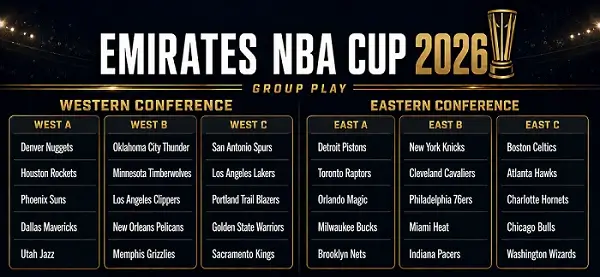
All 30 teams were sorted into six groups of five, split evenly between the Western and Eastern Conferences. Here’s the full table, followed by a card view if you’d rather scan by group.
| Group | Conference | Teams | 2025-26 Combined Wins |
|---|---|---|---|
| West Group A | West | Nuggets, Rockets, Suns, Mavericks, Jazz | 199 |
| West Group B | West | Thunder, Timberwolves, Clippers, Pelicans, Grizzlies | 206 |
| West Group C | West | Spurs, Lakers, Trail Blazers, Warriors, Kings | 216 |
| East Group A | East | Pistons, Raptors, Magic, Bucks, Nets | 203 |
| East Group B | East | Knicks, Cavaliers, 76ers, Heat, Pacers | 212 |
| East Group C | East | Celtics, Hawks, Hornets, Bulls, Wizards | 194 |
Group A
- Denver Nuggets
- Houston Rockets
- Phoenix Suns
- Dallas Mavericks
- Utah Jazz
Group B
- Oklahoma City Thunder
- Minnesota Timberwolves
- LA Clippers
- New Orleans Pelicans
- Memphis Grizzlies
Group C Toughest
- San Antonio Spurs
- Los Angeles Lakers
- Portland Trail Blazers
- Golden State Warriors
- Sacramento Kings
Group A
- Detroit Pistons
- Toronto Raptors
- Orlando Magic
- Milwaukee Bucks
- Brooklyn Nets
Group B
- New York Knicks
- Cleveland Cavaliers
- Philadelphia 76ers
- Miami Heat
- Indiana Pacers
Group C
- Boston Celtics
- Atlanta Hawks
- Charlotte Hornets
- Chicago Bulls
- Washington Wizards
How the Group Draw Actually Works
The NBA doesn’t just throw 30 names in a hat. Each conference’s 15 teams are first sorted into five “tiers” of three teams each, based on final 2025-26 regular-season standings. One team from each tier is then randomly drawn into each of the conference’s three groups, which is why every group ends up with a realistic mix of contenders and rebuilding teams instead of one group getting stacked with all the best teams.
Here’s how that played out in the West this year. Oklahoma City, San Antonio and Denver were the conference’s top three teams, so the tier system guaranteed they’d land in three separate groups (Groups B, C and A). The next tier down, Lakers, Rockets and Timberwolves, split the same way, and so on through the bottom tier of Grizzlies, Kings and Jazz. Every single group in the East follows the identical pattern, tier by tier, down to the lowest-seeded teams. That’s not a coincidence — it’s the whole point of the format, and it’s the mechanic that most coverage of the groups skips over entirely.
Why this matters: because groups are built tier-by-tier rather than pulled from the full 15-team pool at random, no group can end up with, say, four of the conference’s top six teams. It also means the group draw is a pretty direct reflection of last season’s standings — which is exactly why some groups still come out tougher than others.
Which Group Is the Toughest? (2026 Group of Death)
Even with the tiered draw keeping things balanced, groups aren’t identical. Using each team’s actual 2025-26 win total as a rough strength gauge, here’s how the six groups rank from toughest to easiest.
| Rank | Group | Combined 2025-26 Wins | Headline teams |
|---|---|---|---|
| 1 | West Group C | 216 | Spurs (62-20), Lakers (53-29) |
| 2 | East Group B | 212 | Knicks (53-29), Cavaliers (52-30) |
| 3 | West Group B | 206 | Thunder (64-18), Timberwolves (49-33) |
| 4 | East Group A | 203 | Pistons (60-22), Raptors (46-36) |
| 5 | West Group A | 199 | Nuggets (54-28), Rockets (52-30) |
| 6 | East Group C | 194 | Celtics (56-26), Hawks (46-36) |
West Group C is 2026’s “group of death.” It pairs the reigning Western Conference champion Spurs, who reached last year’s Cup final, with a retooled Lakers roster still chasing its first Cup title since 2023, plus a Warriors team that can beat anybody on a given night. There’s no easy get-well game in that group.
On the other end, East Group C is the softest draw on paper — the Celtics are a clear favorite, but the rest of the group (Hawks, Hornets, Bulls, Wizards) is made up of teams still finding their footing, giving Boston a realistic runway toward the knockout rounds.
Keep in mind win totals only tell part of the story — injuries, trades, and how seriously a team’s coaching staff treats these particular four games can flip a “soft” group upside down fast.
How Teams Advance: Format, Wild Cards & Knockout Rounds
Each team plays four Group Play games, one against every other team in its group, on designated Cup Nights between October 30 and November 27. From there:
- The winner of each of the six groups automatically advances.
- The best second-place team in each conference earns a wild-card spot — that’s two more teams.
- That gives you an eight-team knockout bracket: four from the West, four from the East.
- Quarterfinals (Dec. 4–5) and Semifinals (Dec. 8–9) are played in NBA team markets — home-court games for the higher seeds.
- The two conference winners meet in the Championship on Dec. 11 at a neutral site, Hinkle Fieldhouse in Indianapolis.
Does the NBA Cup count toward the regular season? Yes — every Group Play game (and the Quarterfinals and Semifinals) counts in the regular-season standings exactly like any other game. The only game that doesn’t count toward the standings is the Championship itself, since the two finalists have already played their full regular-season slate by that point.
Tiebreaker Rules Explained
Because only the group winner and the conference’s top runner-up advance, ties matter — and with a point-differential tiebreaker in play, you’ll notice teams running up the score late in Cup games more than they would in a normal regular-season blowout. If two or more teams in a group finish with identical records, here’s the order the league uses to break the tie:
- Head-to-head record in Group Play among the tied teams
- Point differential in Group Play (overtime scoring doesn’t count toward this)
- Total points scored in Group Play (again, overtime points are excluded)
- Prior regular-season record
- Random drawing, if every other tiebreaker is somehow still even
The same order applies to sorting out which second-place team in each conference gets the wild card, so a single blowout win in November can end up deciding who gets an extra home playoff-style game in December.
What’s Changed Since the Tournament Began
The in-season tournament has evolved every year since its 2023 debut, and the 2026 edition carries forward the biggest shift from last season: both the Quarterfinals and Semifinals are now played in team markets rather than at a centralized host city, giving higher seeds real home-court advantage deep into the bracket. The Championship itself has also moved — after two years in Las Vegas, this year’s final shifts to Hinkle Fieldhouse in Indianapolis, the college gym made famous by the movie Hoosiers.