
The worst possible week for a star injury is Cup week. Minnesota Timberwolves fans checking the schedule want one clear answer: will Anthony Edwards play in the Emirates NBA Cup 2026?
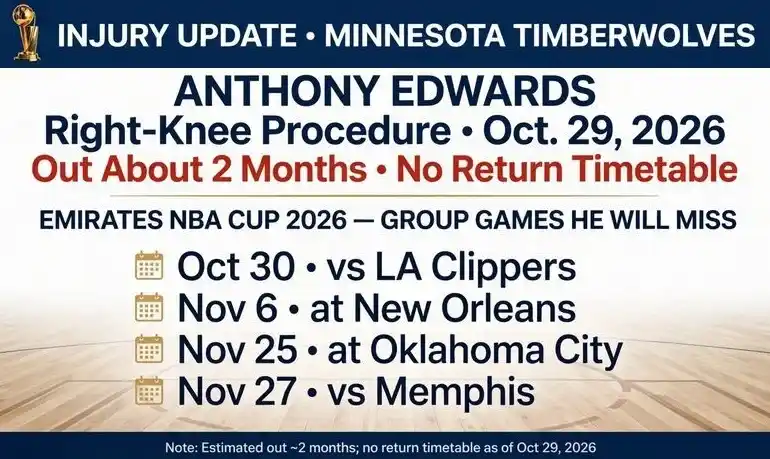
Short answer: Edwards had a successful arthroscopic procedure on his right knee on Thursday, Oct. 29, 2026. The Timberwolves said he is expected to make a full recovery, but the team has not set a return date. Reports put the absence at around two months. On that reported timeline, Edwards would miss all four Minnesota group games, plus any knockout games that followed.
Team confirmed: a successful arthroscopic procedure on the right knee, with a full recovery expected. Reported, not confirmed by the team: an absence of around two months. Unknown: a return date, a re-evaluation date, and the exact return game. A reported timeline is not a team timetable, and a return game should not be treated as settled until Minnesota announces it.
Four Cup Nights, in Order
Minnesota plays in West Group B, with Oklahoma City, Memphis, the LA Clippers, and New Orleans. Each team plays the other four teams once in group play. Minnesota has two home group games and two road group games. The full schedule by date, matchup, and TV broadcast covers every Cup night, and the every group-play matchup, home and away list shows how Minnesota’s four games fit into the wider group picture.
The order below is the order that matters. Each night changes the math for the next one, so a loss on Oct. 30 does not mean the same thing as a loss on Nov. 27.
Fri, Oct. 30: LA Clippers at Minnesota, 8:00 p.m. ET, Target Center, League Pass
The Cup opener is the first test without Edwards, and it comes at home. Minnesota lost the Wednesday game against Golden State 119-114 without him and fell to 3-2, so the opener is also a chance to stop a slide before it starts. A win keeps the group-win route wide open. A loss does not end the Cup, because the wild-card route stays alive, but it makes point difference important from night one. A close loss protects that difference. A heavy loss hurts it.
Home court matters more without a star. Role players tend to shoot and defend with more confidence at home, and the crowd gives Minnesota a lift that cannot be counted on in the two road games. Fans planning to attend can check where to buy tickets for Cup games before buying.
Fri, Nov. 6: Minnesota at New Orleans, 8:00 p.m. ET, Smoothie King Center, League Pass
The first road Cup game without Edwards is a different test. Minnesota cannot rely on a home crowd, and the offense must work in a quieter building. A win here, after either result on Oct. 30, keeps Minnesota in the middle of the group race. A loss here turns Nov. 25 and Nov. 27 into must-win territory. That is the night when second place starts to matter.
Wed, Nov. 25: Minnesota at Oklahoma City, 7:30 p.m. ET, ESPN, Paycom Center
Oklahoma City is the hardest night in the group. The Oklahoma City schedule shows why: Oklahoma City is the strongest team in the group on paper, and this game is on national television. A win here would change the whole group. A loss here is not fatal if Minnesota has banked earlier wins.
Fans can check how to stream Cup games for the right platform on each night. The Nov. 25 game is on ESPN, while the other three Minnesota group games are listed for League Pass coverage.
Fri, Nov. 27: Memphis at Minnesota, 8:30 p.m. ET, Target Center, League Pass
The finale is back at home, and by then the picture is usually clear. Minnesota may be playing for first place, for second place and the wild card, or only for pride and regular-season position. That is why the earlier margins matter. If Minnesota arrives at 2-1, a win can secure a knockout spot. If Minnesota arrives at 1-2, a win may still be enough for a knockout spot, but only if earlier margins help. If Minnesota arrives at 0-3, the Cup is effectively over before tip-off, even though the game still matters for the regular season.
Group play ends on Nov. 27. Edwards is still in the reported absence window at that point.
Three Routes to December
Route one: win the group. Six group winners advance. Minnesota would most likely need at least three wins from four games to win West Group B outright, with four wins making the route certain. A group win avoids any comparison with second-place teams in other groups.
Route two: win the wild card. One wild card from each conference also advances, going to the best second-place team in group play in that conference. That is why every result, and every point, can matter. In simple terms, how the Emirates NBA Cup works rewards winning the group first and staying alive for the wild card second. If two teams finish tied, head-to-head result in group play comes first, then point difference, then total points scored, then last season’s regular-season record, then a random drawing. Wild-card ties skip head-to-head. The Cup standings will show the group picture and the wild-card race as results come in, and the 2026 NBA Cup groups page lists all six groups, so Minnesota fans can compare second-place records across the West.
Route three: out before December. A 1-3 or 0-4 group record, especially with heavy losses, would leave Minnesota out of both the group win and the wild-card race. Cup group games still count as regular-season games, except for the championship game, so those results would still affect regular-season position even after Cup elimination.
If Minnesota advances, the next steps are quarterfinals on Dec. 4 or 5, hosted by the higher seed, semifinals on Dec. 8 or 9, also hosted by the higher seed in 2026, and the championship on Dec. 11. The championship at Hinkle Fieldhouse in Indianapolis is the final step, and the knockout bracket will fill in as group play ends on Nov. 27. Winning the Cup also carries Cup prize money for the team that lifts the trophy. Past winners show how hard a deep run is even with a full roster, and the history of Cup champions and MVPs gives useful context for how rare a Cup win is.
One Replacement Game Plan
Minnesota cannot replace 33.3 points with one player. The scoring must be shared, and the plan must change from the opening minutes to the closing minutes.
In the opening minutes, LaMelo Ball becomes the main creator. Minnesota moved Edwards back to shooting guard after acquiring Ball, so Ball now runs the offense. Ayo Dosunmu and Terrence Shannon Jr. must cut, move without the ball, and finish in transition, rather than waiting for Edwards to create a shot out of nothing. That early movement matters most on the road, where the offense cannot feed off a home crowd.
In the middle of the game, Bones Hyland gives Minnesota shooting in short bursts off the bench, and Jonathan Kuminga adds secondary scoring. Those minutes decide whether Minnesota stays close enough for the final minutes to matter. If the bench scoring dries up, Ball faces double teams earlier, and the offense slows down.
In the closing minutes, Jaden McDaniels must guard the opposing team’s top wing while also making open shots when defenses help toward Ball. Against the Clippers, that means Ball creating, Dosunmu or Shannon cutting and finishing, and McDaniels making open shots. Against Oklahoma City, the same plan must survive against a faster, deeper defense.
Evidence Chain, Backwards
Forward, the decision looks sudden. Backwards, the chain is clearer. Each step below happened before the one above it in time, and each step explains the next one.
- Oct. 29: arthroscopic procedure on the right knee.
- Oct. 28: Timberwolves president Tim Connelly confirms a Thursday cleanup procedure, says Edwards is expected to be good as new, stresses long-term health, and says Edwards wanted to keep playing. Coach Chris Finch calls the news a shock to the group before the Wednesday game against Golden State.
- Oct. 27: a Tuesday MRI shows a change from earlier scans. Reports say the absence will be around two months.
- Monday at Cleveland: Edwards is listed as questionable, still plays 41 minutes, and still scores 47 points in an overtime loss.
- Sunday at home against Toronto: Edwards is seen grabbing his right knee during a home win.
- Season opener at Miami: Edwards tweaks his right knee and still scores 45 points.
- Summer: rest is used instead of a procedure. Earlier scans do not show a case for surgery at that time.
- Last season: right-knee pain limits Edwards to a career-low 61 games. In the playoffs, he hurts his left knee, with a deep bone bruise, and misses 2 games. He also has right-knee inflammation in that run.
Through four games in 2026-27, Edwards averaged 33.3 points, 4.8 rebounds, 3.5 assists, and 2.0 steals. That form makes the decision harder to understand at first glance, and easier to understand in reverse: a player can score 47 points and still need a cleanup, because scoring through pain is not the same as healing.
In plain words, an arthroscopic cleanup uses a small camera and small cuts, rather than a large open cut. A surgeon can look inside the knee, clean out rough or damaged tissue, and smooth areas that cause pain and swelling. Later team reporting described the procedure as debridement, which means removing damaged or thickened tissue. It is not the same as rebuilding a ligament, and no meniscus injury has been confirmed in the team statements covered in the reporting. Connelly said the procedure was not a meniscus issue and did not give a specific diagnosis.
What Closes the Uncertainty
The open questions do not close all at once. Each checkpoint below closes a different question, and common Cup questions are also answered in the common Cup questions resource.
Before the next Cup night, the injury report closes the lineup question. Who starts in place of Edwards? The starter and bench roles are set out in the replacement game plan. Lineups can change by matchup, so the game-day report matters more than any single predicted lineup.
After Nov. 27, the group table closes the advancement question. Can Minnesota still reach December? The answer will be in the record on that night, not in a prediction made in October. A 3-1 or 4-0 record means a group win or a strong wild-card case. A 2-2 record means the comparison across the West decides it. A 1-3 or 0-4 record means the Cup is over, even if the regular season continues.
At the next team update, the return question starts to close. When will Edwards return? No return date has been announced by the team. Reports point to around two months from late October, which would fall in late December. A return date should be treated as unknown until Minnesota announces a re-evaluation or a return-to-practice plan. Is the procedure season-ending? No team statement says the season is over, and the team said a full recovery is expected.
In late December, the awards question closes. NBA awards have a games-played rule. A player must play at least 65 of 82 regular-season games to qualify for MVP and All-NBA honors. Edwards played four games before the procedure. If he misses about 25 games, his maximum total for the season would fall below 65, making MVP and All-NBA eligibility very unlikely, even with a strong return. Reports also linked an MVP or All-NBA honor to a possible four-year, $304 million extension next summer. That link is conditional, not guaranteed, and depends on honors, contract rules, and future decisions.
Next check to wait for: Minnesota’s next team update on re-evaluation or return to practice, then the injury report before the next Cup night.